
You have a strong opinion, solid credentials, and a well-written op-ed sitting in your documents folder. None of that matters if your pitch email never gets opened.
Opinion editors receive dozens of unsolicited submissions daily. The difference between a published byline and an ignored inbox entry comes down to three mechanical elements: a subject line that earns the click, timing that matches the editorial cycle, and a follow-up sequence that signals professionalism without crossing into pestering.
Why Most Op-Ed Pitches Fail Before the Editor Reads a Single Word
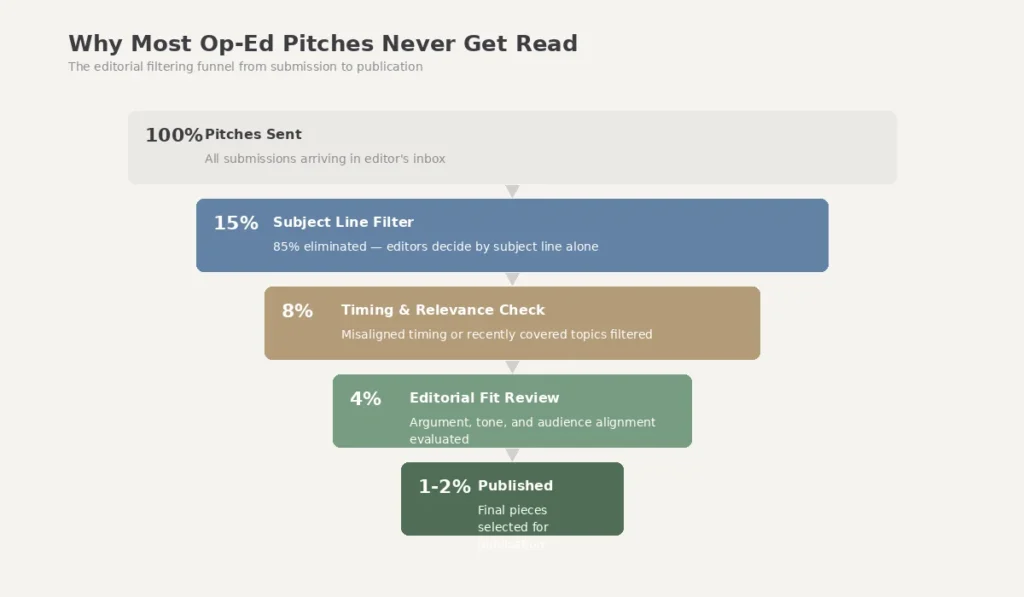
The rejection rate at top-tier publications is staggering. The New York Times opinion desk receives thousands of submissions weekly and publishes a small fraction. But most writers miss the real problem: the majority of rejected pitches are never actually read in full. They are filtered out at the subject line.
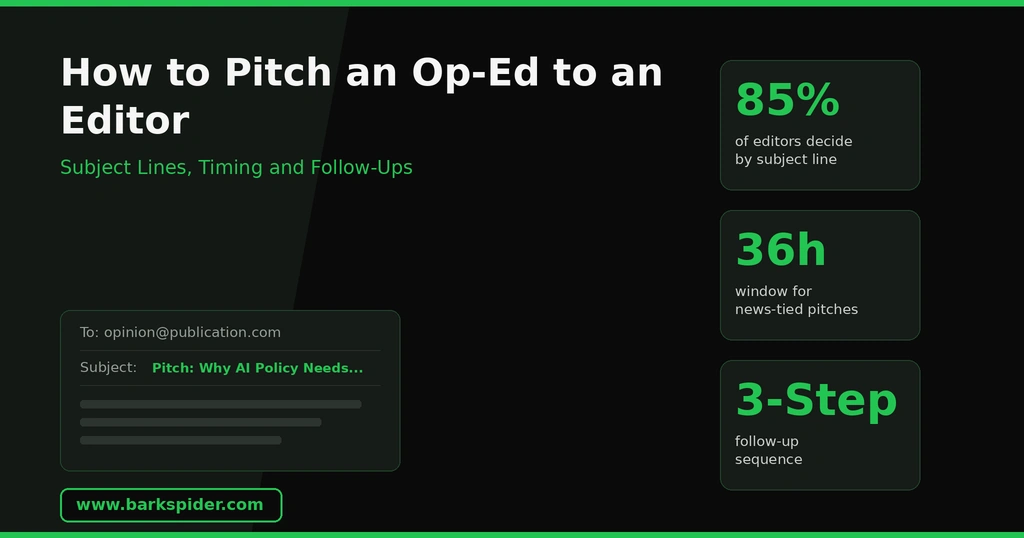
Research from Fractl and Buzzstream found that 85% of media professionals use the subject line alone to decide whether to open a pitch email. If your subject line reads “Op-Ed Submission” or “Article for Consideration,” the editor has already categorised your email as generic.
The three failure points are a vague subject line that gives no reason to click, poor timing that places your pitch after the news cycle has moved on, and no follow-up or an aggressive one that damages the relationship. Each is fixable. If you are building a thought leadership strategy around op-ed placements, understanding pitch mechanics is as important as the writing itself.
How to Write an Op-Ed Subject Line That Gets Opened
Your subject line needs to accomplish three things in under ten words: signal that this is an op-ed submission, communicate the core argument, and give the editor a reason to open.
The Anatomy of a Strong Op-Ed Subject Line
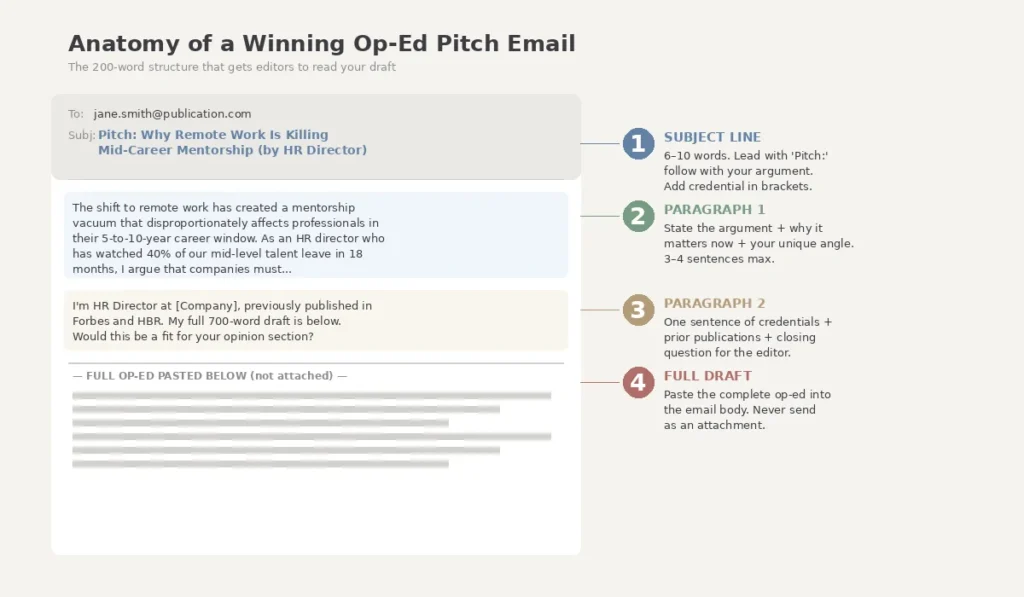
The ideal op-ed subject line falls between six and ten words. Lead with “Pitch” or “Op-Ed” followed by a colon, then a compressed version of your argument that could function as a headline.
Formula: Pitch: [Provocative claim or angle] ([Your credential])
Examples that work:
- Pitch: Remote work is killing mid-career mentorship (by HR director)
- Op-Ed: Why school lunch debt should be illegal (via pediatrician)
- Pitch: India’s AI regulation gap will cost us a decade (tech policy researcher)
Examples that fail:
- New Article for Your Consideration
- Op-Ed Submission — Please Review
- Interesting Perspective on Education Policy
The difference is specificity. Strong subject lines contain the actual argument. Weak ones describe the category. An editor scanning 50 unread pitches will open the one that sounds like a headline over the one that sounds like a filing label.
Personalisation and Referral Signals
If you have a referral from someone the editor knows, put that signal in the subject line. Harvard’s Center for Health Communication recommends formats like “Pitch: [Topic] (via [Referrer Name])” to establish immediate social proof, shifting the email from cold outreach to warm introduction.
When to Send Your Op-Ed Pitch: Timing That Aligns with Editorial Cycles
Timing is not about finding the optimal hour to hit send. It is about aligning your submission with the news cycle and the publication’s editorial appetite.
The 36-Hour Rule for News-Tied Op-Eds
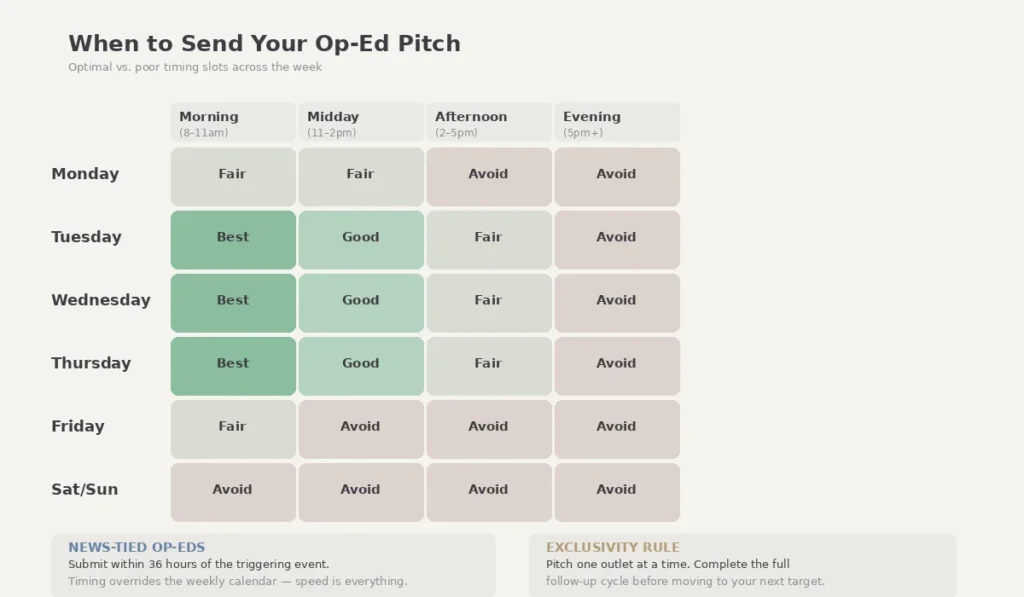
If your op-ed responds to a breaking event or policy announcement, the window is narrow. Industry guidance suggests submitting within 36 hours of the triggering event. After that, editors have likely commissioned responses from regular contributors or the moment has passed.
This does not mean rushing a half-finished draft. Experienced op-ed writers who maintain a content writing discipline prepare “evergreen drafts” on topics they know will resurface, then adapt and pitch within hours when news breaks.
Timing for Evergreen Op-Eds
For evergreen pieces — ongoing policy debates, cultural commentary, industry analysis — the calculus changes. Avoid Mondays (flooded with weekend pitches) and Fridays (buried under the weekend backlog). Tuesday through Thursday mornings, before noon in the editor’s time zone, give your pitch the best chance of landing during active inbox processing. Also watch for competing news cycles — if a major event dominates coverage, your unrelated pitch will be deprioritised regardless of quality.
The Exclusivity Factor
Most major publications require exclusive submissions, meaning you pitch one outlet at a time. Sending the same piece to competing publications simultaneously will damage your credibility with both editors. Plan a tiered strategy: pitch your top-choice outlet first, complete the follow-up cycle, then move to your second choice.
The Follow-Up Sequence: How to Be Persistent Without Being Annoying
The follow-up is where most op-ed pitchers either give up too early or push too hard. Both extremes cost placements. A structured follow-up sequence, calibrated to the urgency of your piece, keeps your pitch visible without burning the editorial relationship.
The Three-Step Follow-Up Framework
Step 1: First follow-up (24–72 hours after initial pitch)
For a timely, news-tied op-ed, follow up within 24 hours. For an evergreen piece, wait three to five business days. Forward your original email — do not write a new one — and keep the follow-up to one or two sentences. A subject line like “Chance to look?” signals polite persistence without pressure.
Step 2: Second follow-up (24–48 hours after Step 1)
If there is still no response, forward the thread again with a subject line like “Assume no?” followed by a brief note saying you plan to pitch the piece elsewhere if it is not a fit. This creates gentle urgency without issuing an ultimatum.
Step 3: Final follow-up (24–48 hours after Step 2)
Send a final forward with a subject line like “Moving on” or “Pitching elsewhere.” Thank the editor for their time, confirm you are submitting to other outlets, and close the door politely. This preserves the relationship for future pitches.
The entire sequence should take no more than seven to ten days from initial pitch to final follow-up. After that, move to your next target outlet and restart the process.
What Not to Do in Follow-Ups
Do not call unless you have an existing relationship — cold phone calls to opinion editors are almost universally unwelcome. Do not rewrite or expand your pitch in the follow-up; it is a nudge, not a second chance to make your case. And do not follow up more than three times. After three attempts, silence is the answer. The professional move when your founder ghostwriting pitch gets no response is to move to the next publication on your list.
Structuring the Pitch Email Body: What Goes Where
The email body needs to be engineered for an editor who will spend no more than 30 seconds deciding whether to read your draft.
The 200-Word Pitch Structure
Keep the pitch under 200 words in two short paragraphs. The first should state your argument, why it matters to the publication’s audience, and why it matters now — lead with the “so what,” not the backstory. The second should establish your credentials in one sentence, name outlets where you have published before with links, and close with a question: “Would this be a fit for [publication name]?”
Below the pitch, paste the full op-ed text into the email body. Do not attach it as a document. Editors want to read without downloading, and attachments add friction.
Common Pitch Email Mistakes
Using “Dear Editor” instead of the editor’s name signals a mass submission. Leading with credentials instead of the argument buries the story. Including your entire professional biography wastes space — one sentence of relevant credentials is enough.
For professionals building a consistent media presence, pairing op-ed placements with a strong LinkedIn ghostwriting strategy creates a compounding visibility loop where each placement reinforces the other.
Choosing the Right Publication: Where to Pitch Your Op-Ed
Targeting matters as much as writing quality. A perfectly crafted pitch sent to the wrong outlet wastes time and delays placement.
Local vs. National Strategy
Local and regional outlets are easier to place in and often reach the exact audience that matters for your argument. National outlets make sense when your argument has broad relevance, but the rejection rates are substantially higher and turnaround times longer.
Matching Your Angle to the Outlet
Before pitching, read at least two weeks of the publication’s opinion section. Look for tone, political range, word count of recent pieces, and whether your topic has been covered recently. If it has, pitch elsewhere — most outlets avoid revisiting topics within a short window. Treat outlet research with the same rigour you would apply to SEO content writing keyword research. The goal is alignment between your argument and the publication’s editorial appetite.
FAQ
How long should an op-ed be?
Most publications accept op-eds between 600 and 800 words. Some outlets like the New York Times accept slightly longer pieces, but staying under 750 words is a safe default for most submissions.
Can I pitch the same op-ed to multiple editors at the same time?
No. Most major publications require exclusive submissions. Pitch one outlet at a time, complete your follow-up sequence, and then move to the next outlet on your list if the first declines or does not respond.
What if an editor asks for revisions?
This is a positive signal. Respond promptly, make the requested changes, and return the revised draft within 24 hours if possible. Editorial revision requests mean the editor is interested enough to invest time in your piece.
Should I hire a professional writer for my op-ed?
If your expertise is in the subject matter rather than writing, working with a professional content writing service can sharpen your argument and improve placement rates. The ideas should be yours; the craft of structuring them for editorial consumption is a separate skill.
How do I know if my op-ed was rejected?
Silence after completing your three-step follow-up sequence is effectively a rejection. Very few editors send formal rejection notices. Move on to your next target outlet without taking it personally — editorial decisions are driven by timing and fit, not quality alone.
