
A potential customer lands on your website or scrolls past your social post. You have two to three seconds before they move on. Static images and text blocks are not enough to hold that attention anymore. This is where animation and motion graphics step in — not as a creative luxury, but as a practical tool that helps brands communicate faster and with more impact.
In 2027, over 91% of businesses will use video as a marketing tool. Motion graphics sit at the intersection of design and video — delivering video-level engagement at a fraction of the production cost of live-action shoots.
This guide breaks down what motion graphics for brands involves, the types that deliver results, where to use them, what they cost, and how to start without wasting your budget.
What Are Motion Graphics and How Are They Different from Animation?
The terms are often used interchangeably, but they serve different purposes.
Animation is the broader category — any technique that creates the illusion of movement. This includes character animation, 3D modelling, stop motion, and hand-drawn frame-by-frame work.
Motion graphics are a specific subset of animation focused on moving graphic elements — text, shapes, icons, charts, and abstract visuals — to communicate information or tell a visual story. Think animated infographics, logo reveals, data visualisations, and UI animations.
The key distinction: character animation tells a story through people or characters. Motion graphics communicate concepts through design elements in motion. For most brand communication, motion graphics are the more efficient and cost-effective choice.
Why Motion Graphics Matter for Modern Brands
The business case for brand animation is built on measurable outcomes, not aesthetics.
Attention and Retention
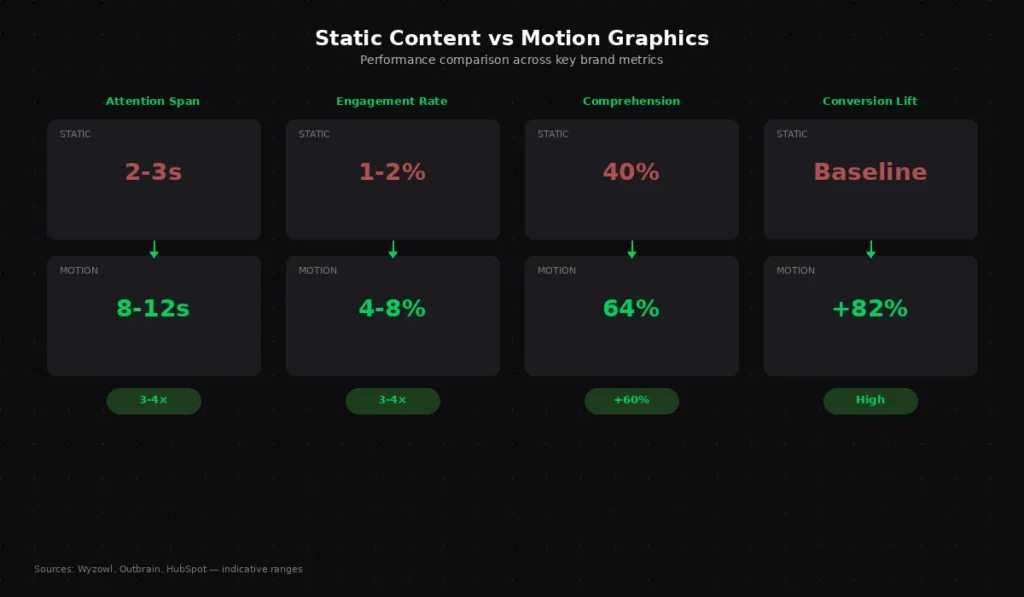
Motion captures attention in a way static content cannot. Animated posts on social media consistently outperform static images in engagement metrics. Research shows kinetic typography assets deliver significantly higher click-through rates on platforms like LinkedIn compared to static ads.
Faster Communication
A ten-second animation can explain what a paragraph of text struggles to convey. For SaaS products and complex offerings, this compression matters — animated explainer videos improve product comprehension by up to 64%.
Conversion Impact
82% of consumers report being more likely to purchase after watching a brand video. Landing pages with video content consistently convert at higher rates than text-only pages.
Brand Consistency
Motion graphics establish a visual language that extends across every touchpoint. Animated logos, transitions, loading screens, and social templates all reinforce brand identity in ways that static assets alone cannot achieve. Working with a graphic design services team that understands both static and motion design ensures visual consistency across every channel.
Types of Animation Brands Actually Use
Not every animation style suits every business goal. Here are the formats that deliver measurable results.
Explainer Videos
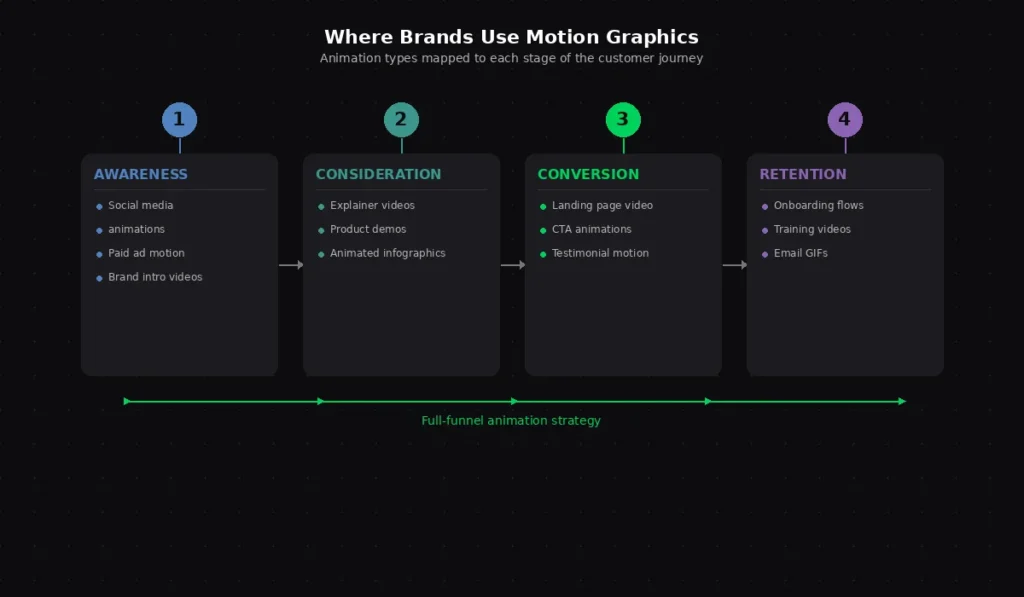
The most widely used format in brand animation. A 60–90 second animated video that explains what your product or service does, how it works, and why it matters. Effective for landing pages, sales decks, and onboarding flows.
Motion Graphics for Social Media
Short-form animated content — 5 to 15 seconds — designed for Instagram Reels, LinkedIn feeds, YouTube Shorts, and paid ads. These include animated quotes, data reveals, product highlights, and event promotions. Animated social media content consistently outperforms static posts in both reach and engagement.
Logo and Brand Identity Animation
Animated logos, brand intros, and transition elements that bring static identities to life. Used across websites, video content, presentations, and app interfaces to create a distinctive, recognisable brand signature.
Product Demos and UI Animation
Screen recordings enhanced with motion graphics overlays — callouts, transitions, and highlighted interactions — that make product walkthroughs engaging and easier to follow. Essential for SaaS and technology brands.
Kinetic Typography
Text-driven animation where words move, scale, and transform to emphasise key messages. Effective for testimonials, statistics, taglines, and social content where the message itself is the visual.
Animated Infographics and Data Visualisation
Charts, graphs, and data points brought to life through motion. Particularly effective for annual reports, case studies, investor presentations, and content marketing where numbers tell the story.
Where Brands Use Motion Graphics Most Effectively
The value of motion graphics for brands comes from strategic placement, not volume. Here are the highest-impact applications:
Website hero sections and landing pages: An animated header or a short product loop immediately communicates what you do. When paired with strong copy from a website development company in Bangalore that builds conversion-focused pages, the combination drives measurably better results than static alternatives.
Social media marketing: Platforms reward video content with better reach. Animated posts, story templates, and short reels keep your brand visible in algorithm-driven feeds.
Paid advertising: Motion graphics in display and social ads deliver higher click-through rates. The movement draws the eye, and the format allows you to communicate a value proposition in seconds rather than relying on a headline alone.
Email marketing: Animated GIFs and micro-animations within emails increase click rates. A moving product showcase or animated CTA button consistently outperforms its static equivalent.
Sales and presentations: Animated slides and data reveals make pitch decks more engaging and easier to follow. Motion design turns a standard presentation into a memorable experience.
What Does Brand Animation Cost?
Pricing varies significantly based on animation style, length, complexity, and who produces it. Here is a realistic breakdown for the Indian market.
| Animation Type | Duration | Freelancer | Studio/Agency |
| 2D Explainer Video | 60–90 sec | ₹15,000–₹50,000 | ₹50,000–₹2,00,000 |
| Motion Graphics Video | 30–60 sec | ₹10,000–₹40,000 | ₹40,000–₹1,50,000 |
| Animated Logo Reveal | 5–10 sec | ₹3,000–₹10,000 | ₹10,000–₹30,000 |
| Social Media Animation | 5–15 sec | ₹2,000–₹8,000 | ₹8,000–₹25,000 |
| Product Demo (animated) | 60–120 sec | ₹20,000–₹70,000 | ₹70,000–₹3,00,000 |
| 3D Animation | 30–60 sec | ₹40,000–₹1,50,000 | ₹1,50,000–₹5,00,000+ |
Three factors drive cost up: custom character design, 3D rendering, and tight deadlines. For most brand needs, 2D motion graphics offer the best balance of quality, speed, and budget.
Common Mistakes Brands Make with Animation
Prioritising Style Over Message
The most polished animation is worthless if it does not communicate a clear message. Start with the script and storyboard. The visual treatment comes second.
Producing One Video and Stopping
A single explainer video is useful but insufficient. Motion graphics for brands work best as a system — a library of reusable animated assets (templates, transitions, branded elements) that your team can deploy across channels consistently. Building a digital marketing strategy around animated content means planning for volume, not just one hero piece.
Ignoring Platform Requirements
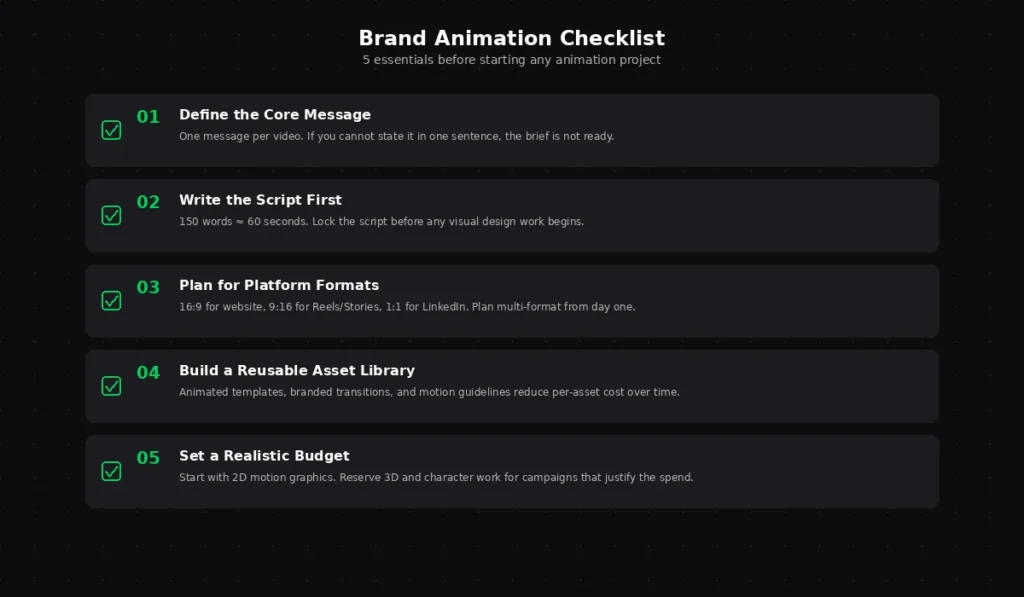
A 16:9 explainer video made for your website will underperform on Instagram, where 9:16 vertical format dominates. Every piece of animated content should be planned for its destination platform from the start, not cropped awkwardly after the fact.
Skipping the Brief
Handing a motion designer a vague brief — “make something cool” — produces revision cycles and budget overruns. Define the audience, message, platform, duration, and desired action before production begins.
Using Animation Where It Adds No Value
Not everything needs to move. A pricing page or a simple contact form does not benefit from animation. Use motion where it compresses information or improves comprehension — not as decoration.
How to Get Started with Motion Graphics
If your brand has not used animation before, here is a practical starting point.
Start with one high-impact asset. An explainer video for your homepage or a set of animated social templates will deliver the fastest return and help you evaluate the process before committing to a larger programme.
Write the script before anything else. The script determines duration, pacing, and the visual direction. A 150-word script produces roughly 60 seconds of animation. Keep it focused on one message per video.
Choose the right style for your budget. 2D motion graphics and kinetic typography offer the best value for most businesses. Reserve 3D and character animation for campaigns where the visual complexity genuinely serves the message.
Build reusable brand assets. Invest in animated templates for social media and branded transitions that your team can reuse across content. This reduces per-asset cost dramatically over time.
Work with specialists. Motion design requires a different skill set than static graphic design. A motion graphics services team that handles scripting, storyboarding, animation, and sound design as an integrated process delivers significantly better results than assembling the pieces separately.
Frequently Asked Questions
What is the difference between animation and motion graphics?
Animation is the broad category that includes all techniques creating the illusion of movement — character animation, 3D, stop motion, and more. Motion graphics are a specific subset focused on moving graphic elements like text, icons, shapes, and data to communicate information. For brand communication, motion graphics are typically faster, more affordable, and better suited to explaining concepts and presenting data.
How long should a brand explainer video be?
For most purposes, 60 to 90 seconds is the ideal range. Website explainers and social ads should be even shorter — 15 to 30 seconds. Attention drops sharply after 90 seconds, so keep the message focused. Product demos and training videos can run longer if the content justifies it.
How much does motion graphics cost for a small business in India?
A basic 30–60 second motion graphics video from a freelancer typically costs ₹10,000–₹40,000. Working with a studio or agency, expect ₹40,000–₹1,50,000 for the same duration with higher production quality, scripting, sound design, and revisions included. Social media animations are significantly cheaper at ₹2,000–₹25,000 per asset depending on complexity.
Can I use the same animation across different platforms?
You can repurpose the core concept and assets, but each platform has different format requirements. A horizontal 16:9 explainer for your website needs to be adapted to 9:16 for Instagram Reels and 1:1 for LinkedIn feeds. Plan for multi-format output from the start rather than cropping after production.
Final Takeaway
Motion graphics for brands are about communicating faster, clearer, and more memorably than static content allows. The brands getting the most value treat it as a system — a library of reusable assets deployed strategically across the customer journey, not a one-off production.
Start with a clear message, choose the right format for your budget and platform, and build from there. A well-executed 30-second social animation can deliver measurable results from day one.
If you are ready to explore how animation and motion graphics can work for your brand, get a quote from BarkSpider — we produce conversion-focused motion graphics for businesses across Bangalore and beyond.
