
A founder publishes a sharp post on Monday and a long article on Thursday. By Friday, neither seems to have changed how customers, investors or candidates see the company. The effort was real, but the strategy behind it was missing.
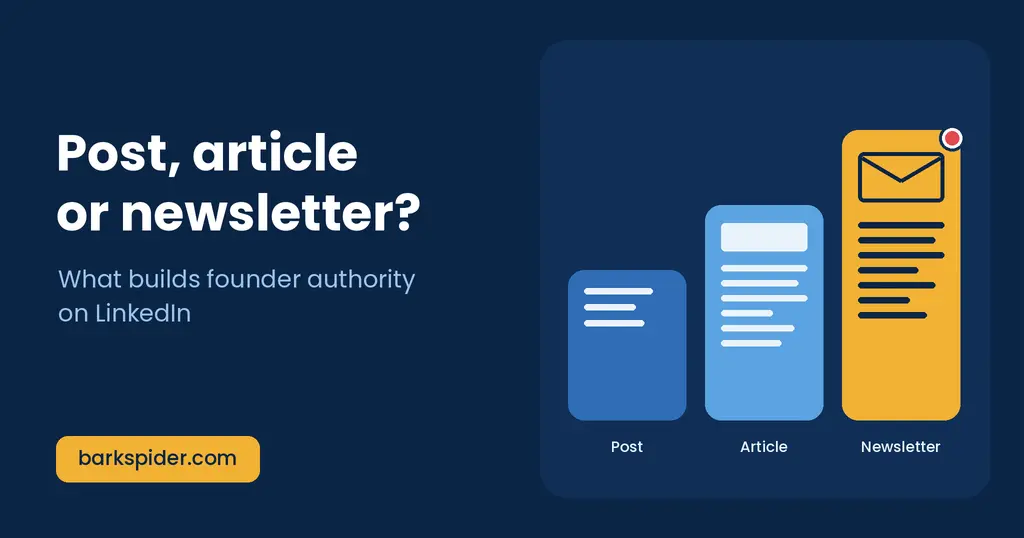
LinkedIn gives founders three main formats for building visibility: posts, articles and newsletters. They look similar from the outside, but each does a different job. Choosing the wrong one wastes time. Combining them well is what builds founder authority, meaning people trust your judgment before they ever speak to you.
This guide explains how each format works, where it is strong, where it falls short, and how a busy founder can use all three without turning content into a second full-time job.
What Founder Authority Actually Means
Authority is not follower count. It is the confidence a stranger feels after reading your work and concluding that you understand their problem better than most people in your category.
For a founder, that confidence shows up in practical ways: warmer sales conversations, easier hiring, inbound partnership requests, and investors who already know your point of view. Three signals build it over time:
- Clarity: a specific position on a specific problem.
- Consistency: a publishing rhythm people can predict.
- Proof: examples, lessons and numbers from your own business.
Each LinkedIn format supports these signals differently. So, the useful question is rarely “which one wins?” and more often “which one does which job?”
LinkedIn Posts: The Fastest Way to Start Conversations
How posts work: A post is a short update that appears in the feed. It can be text, an image, a carousel, a poll or a short video. Who sees it depends largely on how the feed surfaces it, so reach can vary a lot from one post to the next.
Where posts are strong: Posts are the quickest way to test ideas. You can share a lesson from a customer call, a hiring mistake or a pricing decision in a few lines and see what people respond to. Comments also put you in direct contact with your audience. Replies from prospects and peers often reveal which questions deserve a longer answer.
Where posts fall short: Posts are short-lived and rarely hold the full reasoning behind your view. A reader who likes one post has no built-in way to hear from you again, except by following you and happening to see the next one. Posts build recognition quickly, but authority needs more depth behind it.
LinkedIn Articles: Depth That Outlasts the Feed
How articles work: A LinkedIn article is a long-form piece published on its own page, with headlines, subheadings and images. It suits a single, well-argued idea.
Where articles are strong: Articles give you room to show your thinking: the problem, the options you weighed and why you chose what you did. That depth is what separates an opinion from a point of view. Because an article has its own URL, you can reference it in a sales email, proposal, pitch deck or bio, and it keeps working long after the feed has moved on.
Where articles fall short: A standalone article has no subscriber mechanism. Readers mostly find it through the feed, search or a link you share, so each new piece starts close to zero. Founders also tend to publish one article, go quiet, and publish another two months later, which makes it hard to build a rhythm. Articles earn trust, but on their own they do not bring readers back.
LinkedIn Newsletters: The Format That Builds a Returning Audience
How newsletters work: A LinkedIn newsletter is a recurring series with a name, a theme and a schedule. LinkedIn states that each time you publish, subscribers receive email and in-app notifications, and people who follow you are prompted to subscribe if they have not already.
Where newsletters are strong: That notification layer is the real difference. Posts and articles depend on the feed to deliver them, while a newsletter reaches people who have chosen to hear from you. A recurring name and theme also give your ideas a recognizable shape, such as “a fortnightly note on hiring your first sales reps.” That is how people begin to associate you with a topic.
Where newsletters fall short: Newsletters demand rhythm. If a founder publishes four issues and disappears, subscribers learn to ignore the notifications. There is also a platform limit: creators cannot access subscribers’ email addresses, so the audience lives on LinkedIn instead of in a list you own. If that relationship matters, a separate email newsletter can run alongside it.
Which Format Builds Founder Authority Best?
| Post | Article | Newsletter | |
|---|---|---|---|
| Main job | Start conversations | Explain a point of view | Build a returning audience |
| Depth | Low | High | High |
| Staying power | Short | Long | Medium to long |
| Repeat reach | Not guaranteed | No built-in route | Yes, through subscriber notifications |
| Effort | Low | Medium to high | Medium to high, recurring |
| Best for | Testing ideas, visibility | Sales support, reference | Sustained authority |
If you must pick one format to build authority over time, the newsletter has the structural advantage because it pairs depth with repeat access. But a newsletter with no posts to introduce it grows slowly, and posts with nothing deeper behind them stay shallow. The formats work best as a system, with posts bringing people in, long-form writing earning their trust, and the newsletter keeping them.
A Simple Content System for Founders
Consider an illustrative example, not a client result. A founder of a B2B software company sells to HR teams. Here is how a simple system could work for them.
Step 1: Choose one theme
Instead of writing about everything, the founder picks one subject: “How HR teams actually buy software.” Every post, article and newsletter edition supports it. A narrow theme is easier to remember and easier to trust.
Step 2: Assign each format to a job
- Newsletter: one edition every two weeks, each covering a single question buyers ask, with the reasoning shown.
- Posts: two or three times a week, each taking one small piece of that reasoning, such as a customer objection, a lesson from a lost deal or a lesson from a product decision. One post per edition points readers to the full piece.
- Standalone articles: a few cornerstone pieces, such as the company’s pricing philosophy or hiring approach, written to be linked repeatedly in sales conversations.
Step 3: Repurpose, don’t repeat
One strong idea can become a newsletter edition, then three posts that each make a single point, then a carousel that summarizes the argument visually. The founder is not saying the same thing three times. They are presenting different layers of one idea for readers at different levels of interest.
Step 4: Measure what matters
Likes are a weak signal of authority. Better ones include relevant people subscribing, prospects mentioning a piece on a sales call, inbound messages that reference your ideas and candidates who say they follow your writing.
Long-form pieces also tend to perform better when they are clearly structured and use plain language. That helps readers, and it makes writing easier for search engines and AI answer tools to understand.
Common Mistakes Founders Make
Choosing a format by habit. Some founders only post because it is easy, and others only write long pieces because it feels serious. Pick the format that fits the job.
Publishing without a theme. Random topics confuse readers about what they are subscribing to. A newsletter in particular needs a clear promise.
Starting a newsletter without a plan to sustain it. A schedule you can keep for a year beats an ambitious one you abandon in a month. Fortnightly is better than weekly if weekly means skipped issues.
Sharing generic opinions. “Leadership is about listening” earns nothing. A specific decision, its trade-offs and what you would change builds credibility.
Ignoring the writing process. Founders often have strong ideas but little time. Without a repeatable process for capturing, drafting and editing, quality drops or publishing stops.
Best Practices to Apply This Month
- Write down your one theme and the three questions your best prospects ask most often.
- Turn those questions into your first three newsletter editions.
- Draft posts from the same material before the editions go live.
- Keep one real example, such as a mistake, a decision or a number from your own business, in every piece.
- Review results after eight weeks, not eight days. Authority compounds slowly.
Conclusion: Use Each Format for What It Does Best
Posts start conversations, articles show your reasoning, and newsletters bring readers back. Founder authority comes from using them together around one clear theme, on a rhythm you can sustain.
You do not need to publish everywhere or every day. You need a specific point of view, a format for each stage of the reader’s interest, and enough consistency for people to recognize your voice.
If you want help building that system, Bark Spider’s content writing team works with founders on LinkedIn content strategy, long-form writing and SEO-ready content, with design support for carousels and visuals where needed. You can explore our services at barkspider.com.
FAQs
Is a LinkedIn newsletter better than a LinkedIn article?
For building a returning audience, usually yes, because subscribers are notified each time you publish. A standalone article is better for a single cornerstone idea you want to link in sales conversations. Many founders use both.
How often should a founder publish a LinkedIn newsletter?
Publish as often as you can keep up with for at least a year. Fortnightly suits most founders, with monthly working for in-depth analysis. An unpredictable schedule teaches subscribers to ignore your notifications.
Do LinkedIn posts still matter if I have a newsletter?
Yes. Posts help new people discover you, and they are the easiest way to test which ideas resonate. Use them to introduce your newsletter editions and share smaller lessons between issues.
Can a ghostwriter help with founder-led content?
Yes, provided the ideas, opinions and experiences come from the founder. A good writer captures your voice, structures the argument and keeps you on schedule, so your expertise reaches readers without taking over your calendar.
