
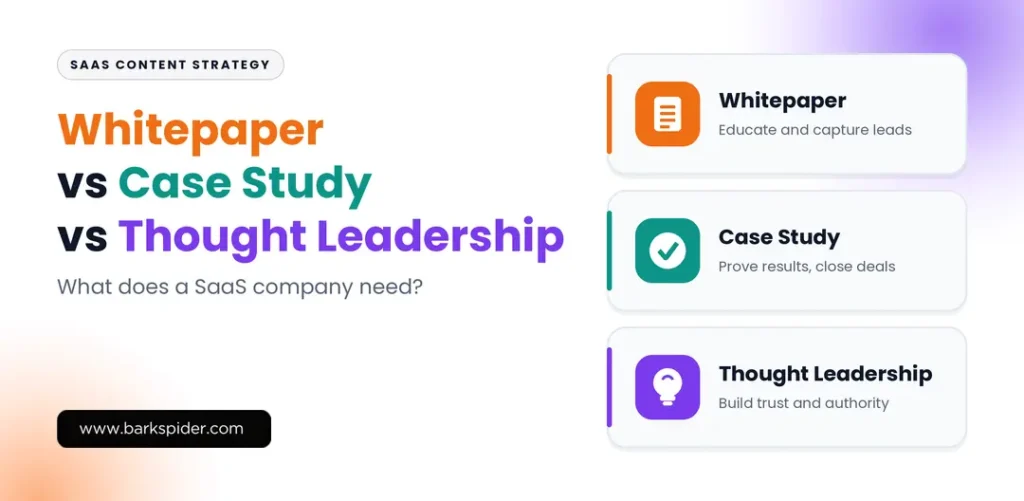
Sooner or later, every growing SaaS company asks the same question: should we publish a whitepaper, write a case study, or invest in thought leadership? Budgets are limited, writers are busy, and the sales team keeps asking for “something we can send to prospects.” Pick the wrong format first, and weeks of effort never reach the people who matter.
These three formats are not rivals. They answer different buyer questions at different moments. This guide explains what each one does, how they compare, and how to decide what to build first based on your stage, audience, and sales bottlenecks.
What Each Content Format Actually Does
Whitepaper: Explains a Problem in Depth
A whitepaper is a long, research-backed document that explores a problem and presents a reasoned approach to solving it. Most run 8 to 20 pages, with data, frameworks, and a clear argument. It is usually gated behind a form, which makes it a lead generation asset.
Whitepapers work best when buyers must understand something complex before they can judge vendors. A SaaS company selling a compliance platform or an API-led product often has prospects who need to justify the purchase to technical and finance stakeholders. A good whitepaper gives them the material to do that.
The risk is cost and quality. A whitepaper that reads like a product brochure gets downloaded once and forgotten.
Case Study: Proves That Your Product Works
A case study tells the story of one customer: the problem they faced, why they chose you, how they implemented the product, and what changed afterward. It is the most direct proof a SaaS company can publish.
Buyers trust other customers more than they trust vendors. A strong case study answers the question that stalls most deals: “Has this worked for a company like ours?” It is used late in the buyer journey, by sales teams during evaluation and on product or pricing pages.
The limitation is dependency. You need a willing customer, measurable results, and often internal or legal approval, which can take weeks. Never inflate or invent numbers. One vague or exaggerated claim damages the credibility of the whole page.
Thought Leadership: Builds Trust Before the Buyer Is Ready
Thought leadership shares a point of view on your industry: where it is heading, what most teams get wrong, and what you have learned from building in the space. It shows up as opinion articles, founder essays, research commentary, podcasts, and LinkedIn posts.
It rarely drives immediate sign-ups. Its job is to make your brand recognisable and credible long before a prospect starts comparing vendors. It also supports search and AI-generated answers, because original ideas and clearly explained expertise give search engines and answer engines something worth citing.
It is the slowest format to pay off and the easiest to fake. Recycled industry advice with a logo on it is not thought leadership. It is noise.
Whitepaper vs Case Study vs Thought Leadership at a Glance
| Format | Main Purpose | Buyer Stage | Best For | Time to Impact | Effort |
| Whitepaper | Educate and capture leads | Consideration | Complex or technical products | Medium | High |
| Case Study | Prove results | Decision | Closing deals, shortening sales cycles | Fast | Medium |
| Thought Leadership | Build authority and awareness | Awareness | Long-term brand and search visibility | Slow | Ongoing |
How a SaaS Company Should Choose Based on Growth Stage
Early Stage: Start With Thought Leadership and One Case Study
With a handful of customers and a small team, your biggest challenge is being found and believed. Publish a few sharp articles built on your founders’ real experience, and invest in one strong case study from your best early customer. A whitepaper can wait. You likely don’t yet have the data or audience to make it worthwhile.
Growth Stage: Add Case Studies and a Flagship Whitepaper
Once inbound interest is steady and a sales team is in place, deals tend to stall at evaluation. This is where case studies pay off. Build a small library organised by industry, company size, or use case, so a prospect can find a story that looks like theirs. A flagship whitepaper also makes sense now, especially if your product generates proprietary data you can share.
Scale Stage: Run All Three as a System
At scale, the formats reinforce each other. Thought leadership creates awareness, a whitepaper captures leads, and case studies close them. One whitepaper can also become a webinar, several articles, and a month of social posts, which improves the return on the original effort.
Match the Format to Your Buyer’s Journey
Another useful method is to map each format to a stage in the journey:
- Awareness: the buyer realises they have a problem. Thought leadership and educational articles help here.
- Consideration: the buyer compares approaches. A whitepaper helps them understand the options and build an internal case.
- Decision: the buyer compares vendors. Case studies, comparison pages, and demos carry the most weight.
Then look at where your pipeline leaks. If few people know you exist, you have an awareness gap. If leads arrive but don’t convert, you have a proof gap. If prospects engage but can’t win internal support, you have an education gap. Each gap points to a format.
A Realistic Scenario
Consider a hypothetical SaaS company that sells inventory software to mid-sized retailers. It has around 40 customers, steady demo requests, and a sales team that keeps losing deals at the final stage because prospects want proof from similar retailers.
The instinct might be to launch a whitepaper. But the real problem is proof, not education. The better first move is two or three case studies from retail customers, each with a clear before-and-after story. Once those are live and sales is using them, the company can invest in a whitepaper on inventory planning and in founder-led articles to widen its reach.
This is an illustration, not a client result. It shows the logic: diagnose the bottleneck first, then choose the format.
Common Mistakes SaaS Companies Make
- Starting with the format instead of the problem. Ask what is slowing growth before deciding what to write.
- Turning a whitepaper into a sales pitch. If the first pages talk about your product instead of the buyer’s problem, readers leave.
- Publishing vague case studies. “Improved efficiency” says nothing. Name the metric, the timeframe, and the context, with the customer’s approval.
- Treating thought leadership as a one-off campaign. One article won’t build authority. Consistent, original publishing over several months will.
- Gating everything. Gating suits a high-value whitepaper, but opinion pieces and case studies should be easy to read and share.
- Skipping distribution. A finished asset with no plan for email, sales enablement, and search is only half done.
Best Practices to Get More From Each Format
Make Content Easy for Search and AI Tools to Understand
Whatever the format, use clear headings, direct answers to specific questions, and visible author and company context. Search engines and AI answer tools favour content that is well structured and genuinely informative. Publishing an ungated summary of a whitepaper’s key findings, for example, lets your ideas surface in search and answer engines while the full report still generates leads.
Build on Original Material
Proprietary data, customer interviews, and your team’s lived experience separate a strong piece from a generic one. Even a small internal data set, such as anonymised usage patterns shared with permission, can anchor a whitepaper.
Repurpose With Purpose
One well-researched whitepaper can become a blog series, a webinar, a short video, and a sales deck. Good design and motion graphics help here. A short animated walkthrough of a case study, or a designed summary of a whitepaper’s findings, often earns more attention than a PDF alone.
Measure What Each Format Is Meant to Do
Track the outcome each format exists for: organic visibility and branded search for thought leadership, qualified leads for whitepapers, and win rates or sales-cycle length for case studies.
Conclusion
A SaaS company doesn’t need to pick one format forever. It needs to pick the right one first. Whitepapers educate and capture leads, case studies prove results and close deals, and thought leadership builds the trust that makes both work harder. Start by finding where your funnel is weakest, match the format to that gap, build it well, and add the next format once the first is working.
If you are planning content for your SaaS business and aren’t sure where to begin, BarkSpider can help you map your funnel, shape a content plan, and produce SEO-ready whitepapers, case studies, and long-form articles. Explore BarkSpider’s content writing and digital marketing services to see how we can support your next stage of growth.
FAQs
Which content format should a SaaS startup create first?
Most early-stage startups do well with thought leadership paired with one strong case study. The first builds visibility and trust, and the second gives early prospects proof. A whitepaper usually makes more sense once you have more data and a larger audience.
Are whitepapers still worth it for a SaaS company?
Yes, when your product is complex or your buyers need to justify a purchase internally. They are less useful when the problem is simple or when your main gap is proof rather than education.
How long should a SaaS case study be?
Most work well at roughly 600 to 1,000 words. Length matters less than specifics: a clear problem, the solution, measurable results, and a customer quote you have permission to use.
Can one piece of content serve all three purposes?
Not fully. A founder-led article can build authority, and a case study can include educational insight, but each format has a distinct job. A better approach is to create one core asset and repurpose it across the others.
